The Guide’s Earpiece: How the Convoy Stays in Touch
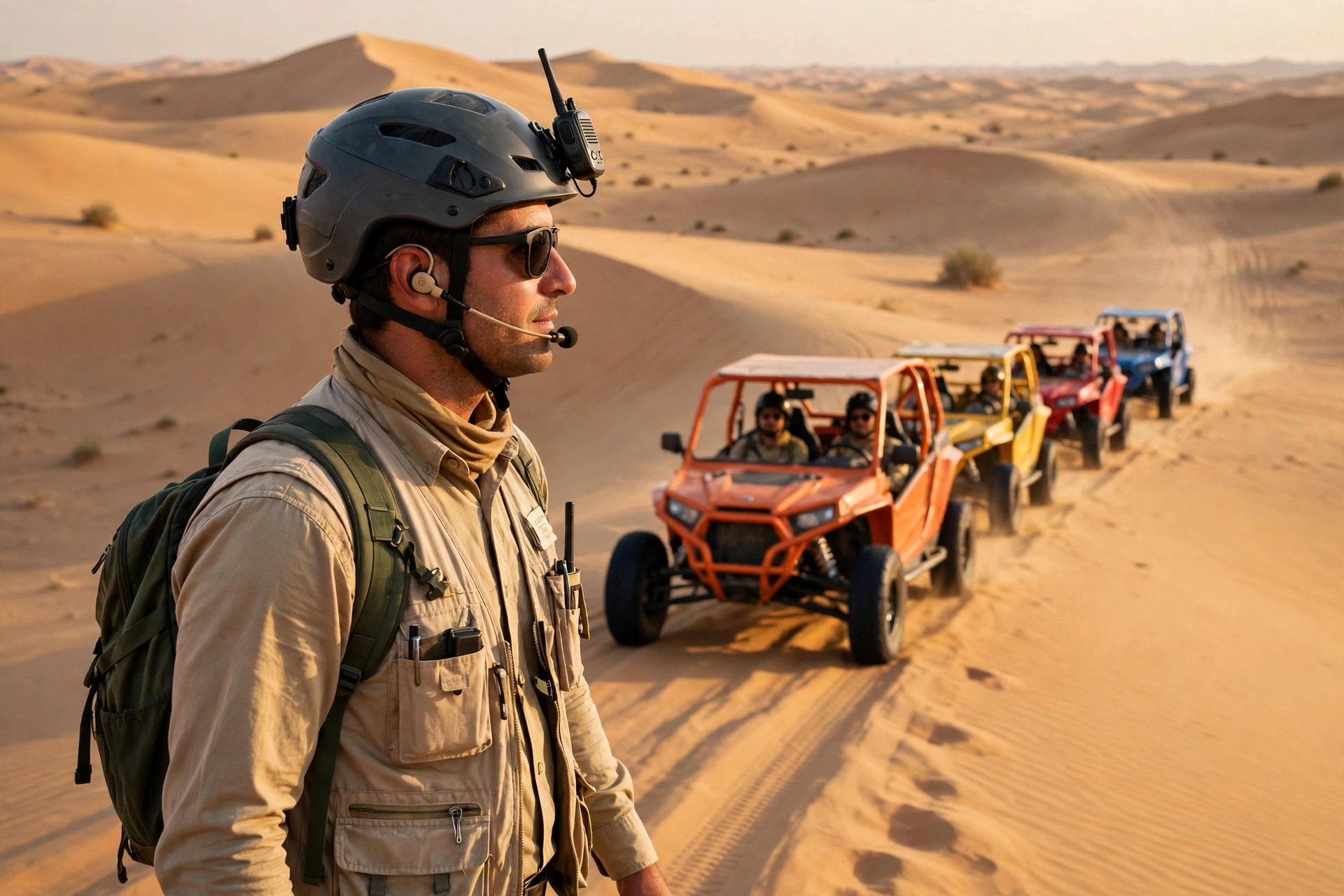
A dune buggy convoy looks simple from the outside. A line of buggies, one behind the other, moving over the dunes. But someone has to hold that line together. That is the guide’s job, and the small earpiece in the guide’s ear is a big part of how it gets done.
It is how the guides talk to each other while the engines run and the wind blows. In a convoy, staying in touch is what keeps the ride smooth and safe.
Why a convoy needs to talk
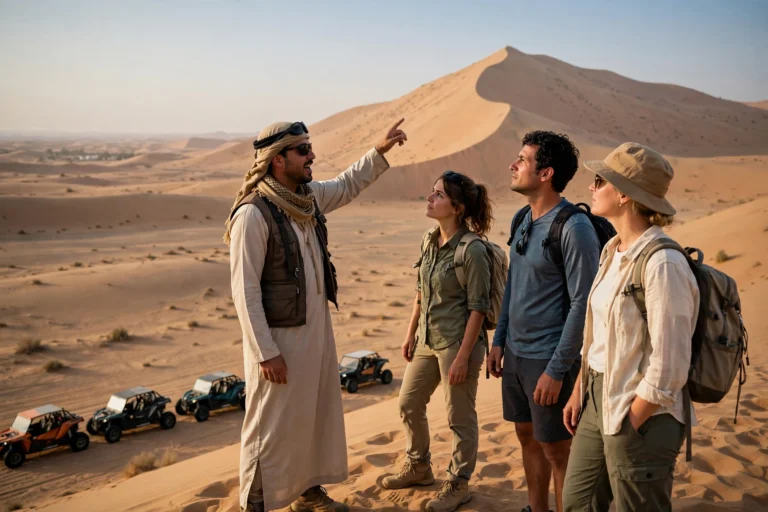
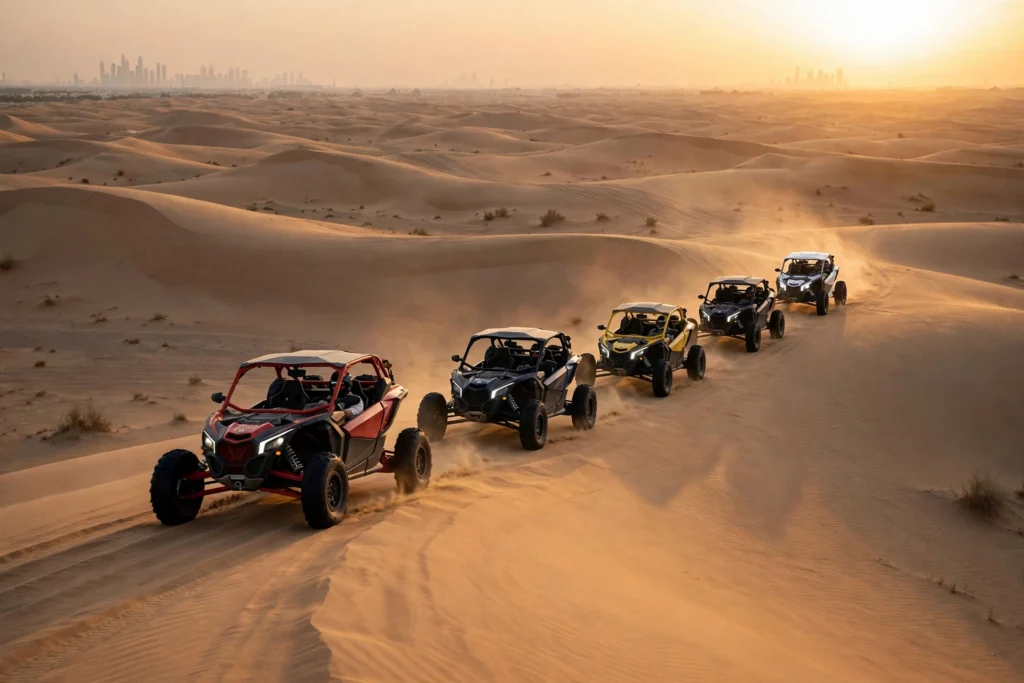
A buggy convoy is a group of vehicles moving as one. The lead guide picks the route. The other guides watch the riders behind. If one buggy slows down, or one rider takes a wrong line, the guides need to know fast.
Shouting does not work. The engines are loud. The wind is loud. The buggies are spread out over the sand. So the guides use radios. One short message, and the whole team knows what is happening. That is how a long line of buggies stays one group instead of turning into a scattered set of riders.
The earpiece itself
The earpiece is small. It sits in the guide’s ear, with a wire running down to a radio. Some guides use a mic near the mouth. Others use a button on the chest or the handlebar. One press, and they can speak.
It fits under a helmet and stays put when the buggy bounces over a dune. It lets the guide hear a message and keep both hands on the wheel. That last point matters. A guide should never need to let go of the wheel to talk.
The lead buggy sets the pace
The lead buggy is the first one in the line. The lead guide drives it and picks the route and the speed. Everyone else follows.
The pace is set for the slowest rider in the group, not the fastest. That is a rule. If one rider is new and careful, the whole convoy moves at a speed that suits them. The lead guide will slow down before a tricky dune and speed up a little on a flat, open stretch.
The lead guide also picks the line. On soft sand, the line matters. The lead buggy cuts the first track, and the buggies behind follow it. If the lead guide sees soft sand or a sharp drop, the radio call goes out before anyone reaches it.
The back guide watches the tail
At the end of the line is the back guide. This guide watches the last buggies for a rider who falls behind, a buggy that slows, or a rider who looks unsure.
The back guide and the lead guide talk the most. The back guide says “all clear” when the tail is fine, “slow down” when the last buggy is falling back, and “stop” when a buggy has a problem.
If a buggy stops, the back guide stops with it. The back guide checks the rider and the buggy, then radios the lead guide, who brings the group to a stop at a safe spot.
Hand signs, for when the radio stays quiet
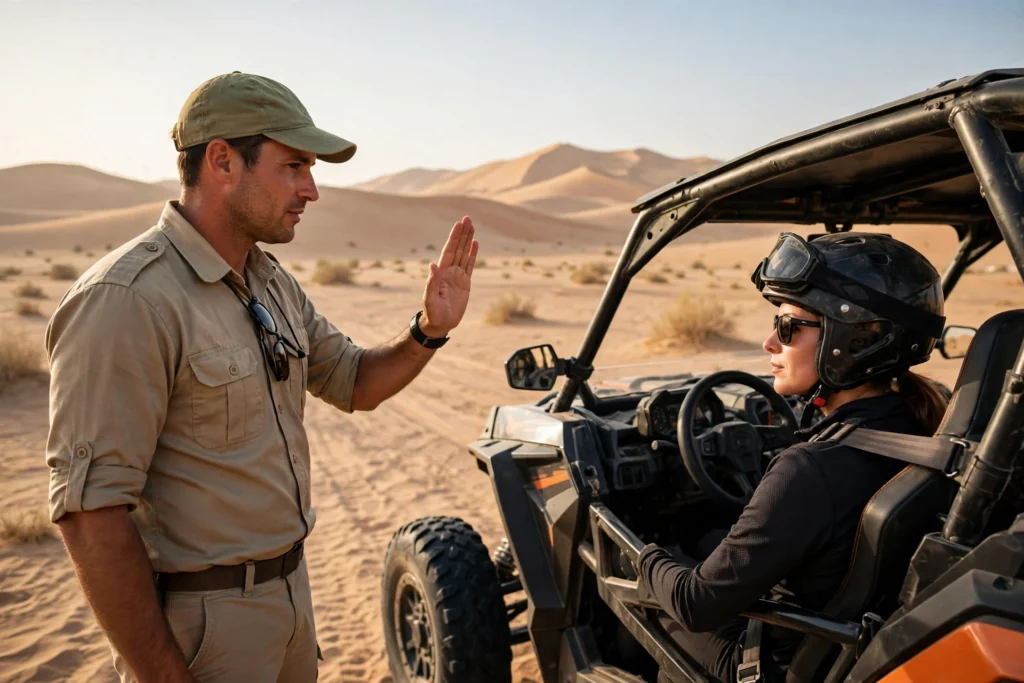
Radios do most of the work, but hand signs do the rest. A guide uses a hand sign when the radio is busy, when the message is simple, or when the guide wants the rider to see it as well as hear it.
A raised hand means stop. A wave forward means go. A hand pointing to one side means move that way. A hand patting the air means slow down. These signs are simple, and every guide uses the same ones, so there is no guessing.
A rider can use hand signs too. A raised hand tells the guide you want to stop. A thumbs up says you are fine. A wave of the hand says you need help. If you are unsure, stop and raise your hand. A guide will come to you.
What the guides say on the radio
Most radio talk is short and plain. There is no long chat on the channel. A guide says what is needed, then stops talking.
You might hear “slowing down”, “stop ahead”, “turn left”, “soft sand”, or “all clear”. Short words, clear meaning. The guide at the front calls the route. The guide at the back calls the tail.
When the convoy stops
A convoy stops for three reasons: a planned stop, a rider who needs a break, or a problem with a buggy. The stop works the same way each time.
The lead guide picks a flat, safe spot. The radio call goes out: “stopping here”. Each buggy pulls in behind the one in front. The engines switch off. The guides walk the line and check the riders and the buggies. At a planned stop, this is when you take photos and have a drink of water. The convoy waits together. No buggy leaves on its own.
Quick questions
Do I need a radio or an earpiece to ride in a convoy?
No. The guides carry the radios. Your job is to follow the buggy in front, watch for the guide’s hand signs, and stop if a guide tells you to.
What should I do if I fall behind the group?
Slow down, stay on the track, and keep going. The back guide will stay with you or come back for you. Never try to catch up by driving fast over ground you cannot see.
Can I ride at my own speed in a convoy?
No. A convoy moves as one group, at a pace set for the slowest rider. That is what keeps it safe.
The small earpiece does a big job
The guide’s earpiece is easy to miss. It is small, quiet, and hidden under a helmet. But it is what holds a convoy together: the lead guide calling the route, the back guide watching the tail, and a short radio message keeping every buggy in the same group.
Next time you ride, look for the earpiece on your guide. Then just follow the buggy in front, watch the hand signs, and enjoy the dunes.
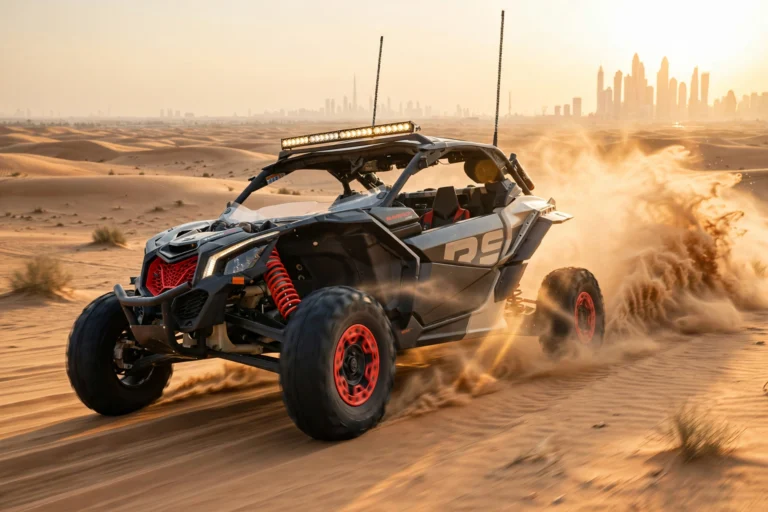
If you want to ride in a convoy yourself, look at the buggy rental or the Can-Am Buggy Maverick X3 – or the desert safari – and message us on WhatsApp at +971 55 719 0598.