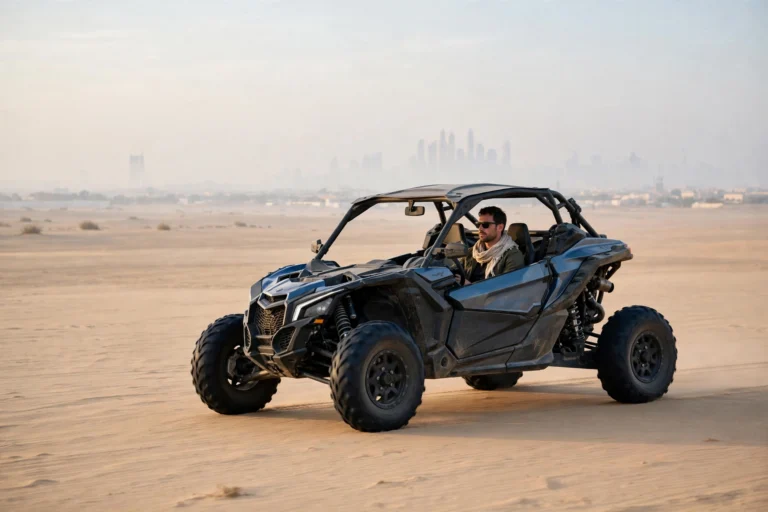
Your Buggy’s Controls, One by One
Your Buggy’s Controls, One by One
If you have never driven a dune buggy, the controls can look strange at first. The wheel is big. The pedals feel different. There are levers you have never seen in a normal car. This guide walks through the dune buggy controls one by one, in plain words, so that nothing in the buggy feels new when you sit down.
You do not need to learn all of this by heart. Your guide will go through it with you before the ride starts. But reading it first means you can listen once and feel ready.
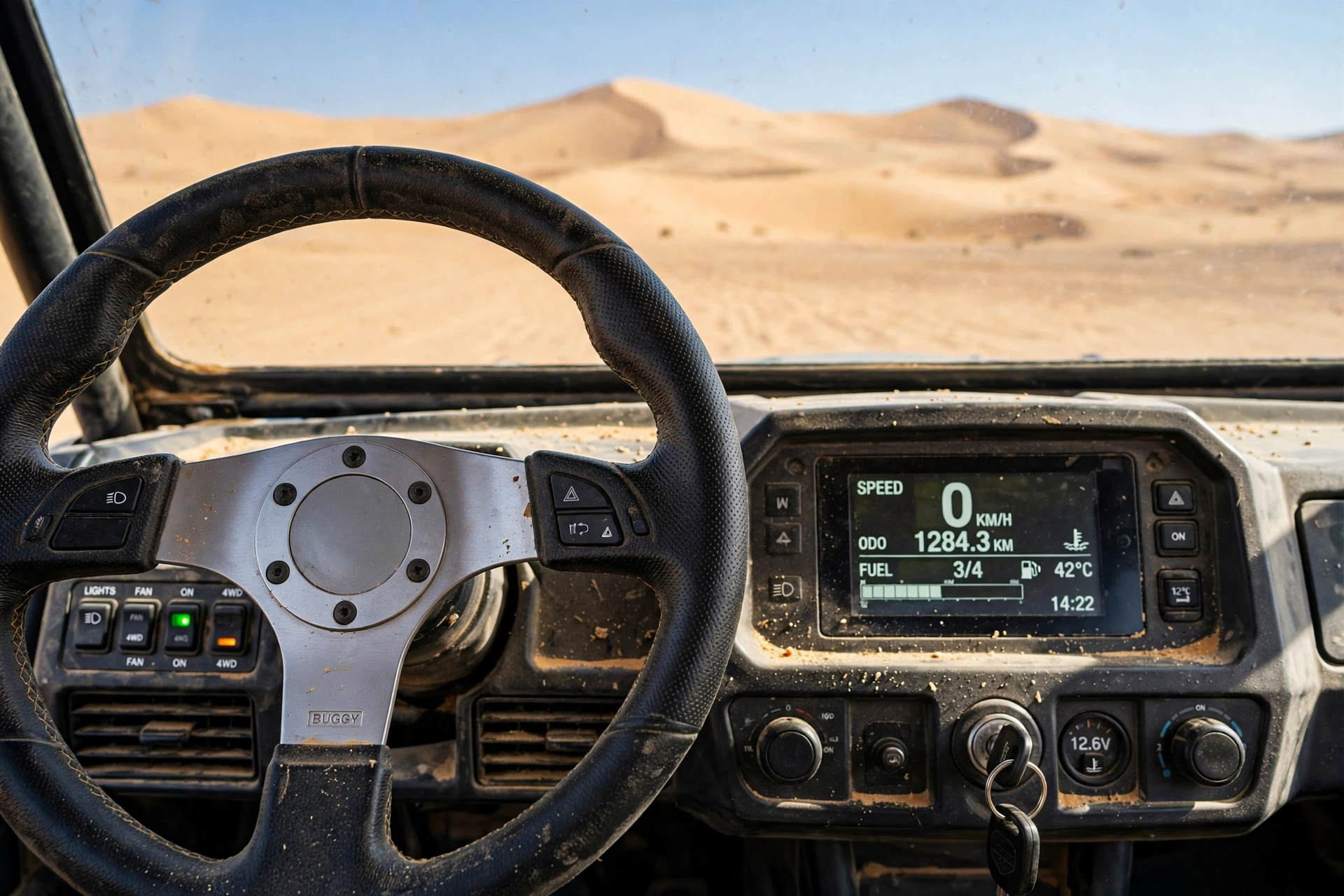
The steering wheel
The steering wheel is the biggest thing in front of you. It turns the front wheels, just like in a car. But it feels heavier. The sand pushes back, and the big tyres make the wheel slow to turn at low speed.
Hold it with both hands. Keep your thumbs on the outside of the rim, not hooked through the spokes. If a front wheel hits a hard patch of sand, the wheel can kick, and thumbs inside the spokes can get hurt.
Steer with small moves. On sand, a big yank of the wheel does not help. Small, smooth turns keep the buggy going where you want.
The gas pedal
The gas pedal sits on the right, under your right foot. Press it to go. Ease off to slow down. It works just like a car pedal, but the buggy answers faster. A small press gives a lot of power, because the buggy is light and the engine is strong.
The trick is to be gentle. Press the pedal a little at a time. If you floor it, the wheels spin in the sand and you go nowhere. Smooth and steady beats fast and hard.
On the dunes, your guide will tell you when to give it more gas, like on the way up a steep slope. Listen for that call. It is the difference between climbing the dune and stopping halfway up.
The brake pedal
The brake pedal sits to the left of the gas pedal. Press it to slow down or stop.
Brakes on sand work differently from brakes on a road. The buggy takes longer to stop, because the wheels slide a little on the loose sand. So brake early. Give yourself more room than you think you need.
Never slam the brake at speed on a dune slope. A hard stop on loose sand can slide the back of the buggy sideways. Press the pedal firm and smooth, and let the buggy slow down on its own.
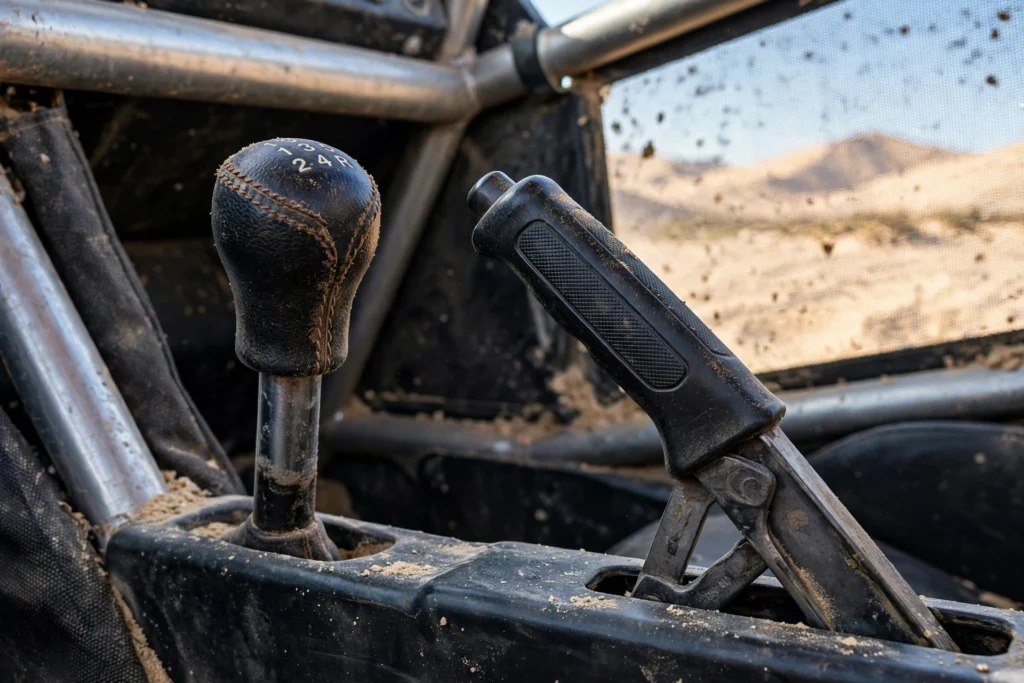
The gear stick
Most of the buggies you will drive have an automatic gearbox, or a simple forward and reverse lever. There is no clutch pedal to worry about, and no gears to change by hand while you drive.
The gear stick usually has three spots: forward, neutral, and reverse. Your guide will set it for you before you move off. You will stay in forward for the whole ride.
If you ever need reverse, stop fully first, then ask your guide. Reversing on a dune needs a clear look behind you, and your guide will help you do it right.
The handbrake
The handbrake is a lever between the seats, or a small lever near the gear stick. Pull it up to hold the buggy still. Push it down to release it before you drive.
You will use it when the group stops for photos or a break on a slope. The guide will tell you to pull it up so the buggy does not roll. On sand, a buggy can creep downhill on its own.
Before you drive off again, check that the handbrake is fully down. If it is still half up, the buggy will feel slow and the brakes will heat up. Your guide checks this too.
The 4×4 switch
Some buggies have a switch or lever that turns on four-wheel drive. This sends power to all four wheels instead of just two. It gives you more grip in soft sand.
You will not need to touch this switch. Your guide sets it before the ride, based on the sand that day.
The seatbelt and the seat
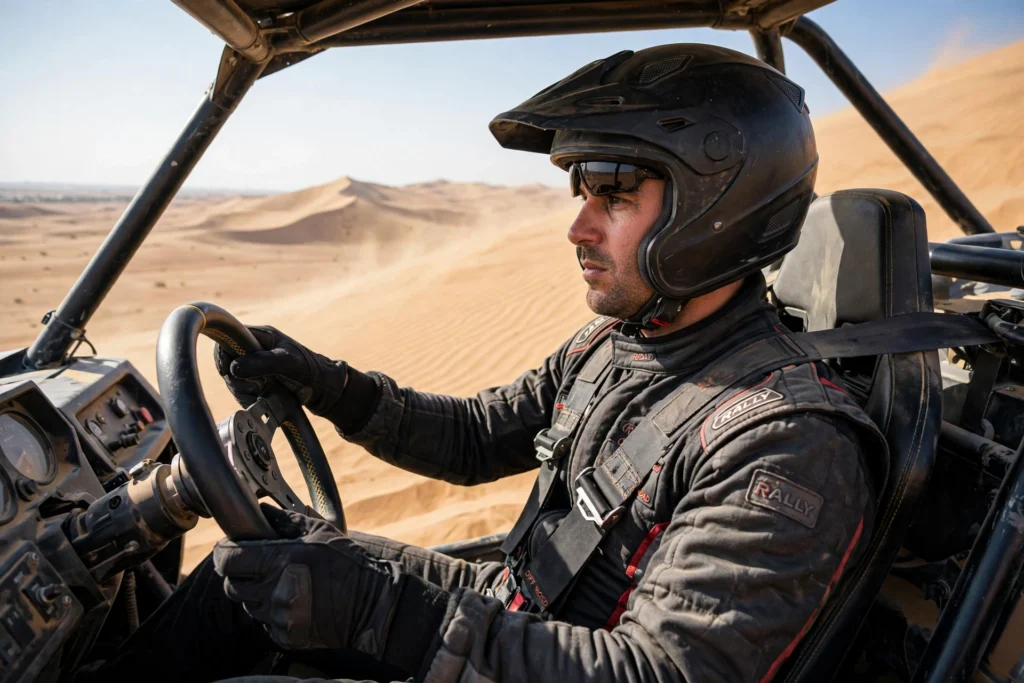
The seatbelt in a buggy is a four-point harness in many models — two straps over the shoulders and one across the lap. Pull the straps tight. It should feel snug, not loose.
Adjust your seat before you drive. You should reach the pedals with a small bend in your knees, and see clearly over the front of the buggy. If you cannot reach, tell your guide.
What your guide does before you drive
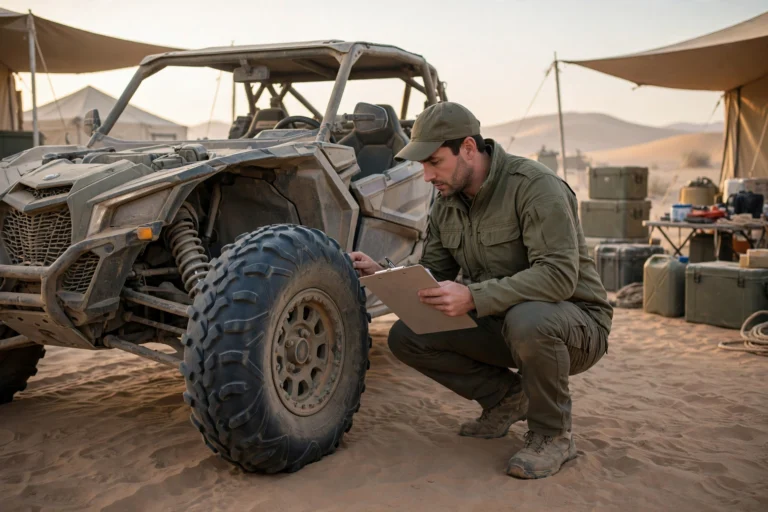
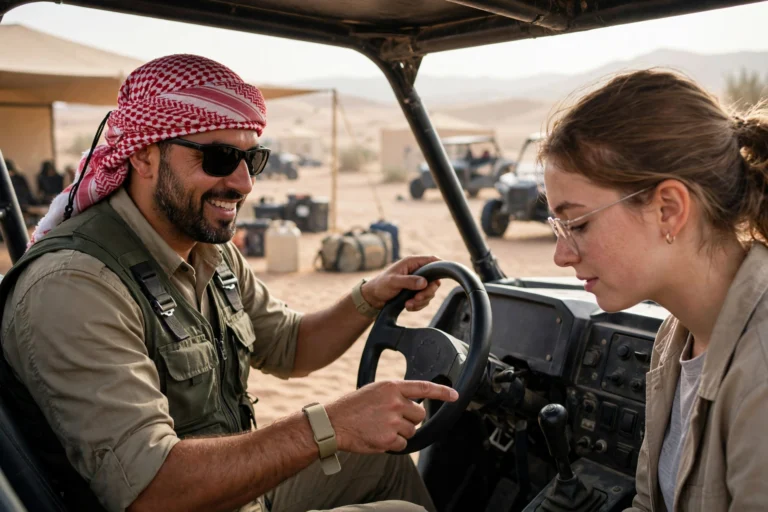
Before anyone moves, the guide walks around the buggy and checks it: tyres, steering, brakes, fuel, and the harness. Then they sit with you and point at each control while they explain it. Ask questions here.
Then comes a short practice run on flat sand. You drive slowly, try the steering, the gas, and the brake, and get a feel for the buggy. This takes a few minutes and it makes a big difference.
Quick questions
Do I need to know how to drive a car first?
It helps, but it is not required. The controls are simple, and the guide talks you through them. Many first-time riders have never driven anything before.
Is the buggy automatic or manual?
The buggies used for guest rides are automatic. There is no clutch and no gear changes while you drive. You only use the gas and the brake.
What if I press the wrong pedal?
The pedals are far apart and clearly placed. If you do mix them up, lift your foot straight away and the buggy slows down. Your guide is right there in the convoy and will stop the group.
Sit down, check, drive
That is all of it. Wheel, gas, brake, gears, handbrake, and the 4×4 switch your guide handles. Nothing here is hard. The buggy is built for first-timers, and the guide is with you for the whole ride.
If you want to see the buggy up close before you book, look at the Can-Am Buggy Maverick X3 or browse the buggy rental page — or contact us and message us on WhatsApp at +971 55 719 0598. Tell us it is your first time, and we will pair you with a guide who takes it slow.